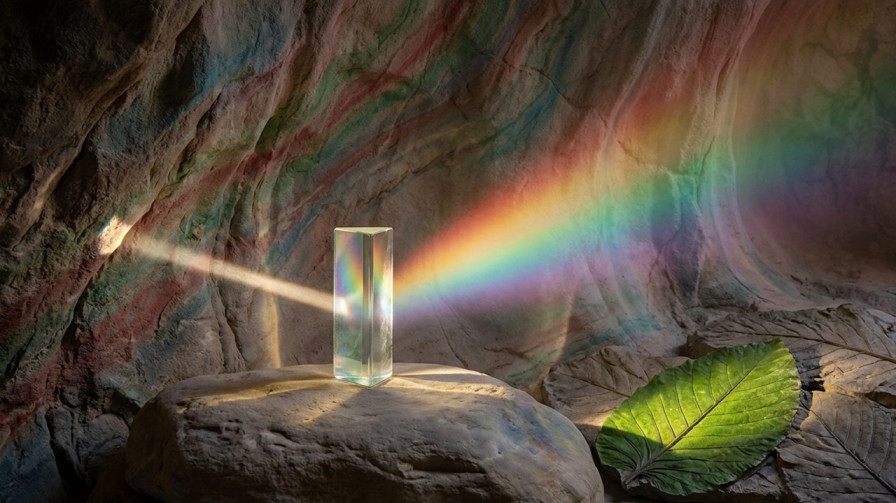
The world is a kaleidoscopic explosion of hues, yet color does not exist “out there” in the way we often imagine. It is not a physical coating on the surface of objects, but rather a sophisticated collaboration between physics, chemistry, and biological perception. To understand the origin of colors, we must look at the intersection of light’s behavior and the evolution of the human eye.
The Physics: Light as the Source
The story begins with Isaac Newton. In 1666, Newton performed a landmark experiment by passing a beam of white light through a glass prism. He discovered that white light is not “pure,” but is actually composed of a spectrum of distinct colors: red, orange, yellow, green, blue, indigo, and violet.
In physical terms, color is a property of electromagnetic radiation. Each color corresponds to a specific wavelength of light. Visible light sits on a narrow band of the electromagnetic spectrum, with wavelengths ranging from approximately 380 nanometers (violet) to 750 nanometers (red).
The Chemistry: Absorption and Reflection
When light hits an object, the object’s molecular structure determines which wavelengths are absorbed and which are reflected. This is the “origin” of an object’s color.
- Pigmentation: Most colors we see are the result of chemical pigments. For example, a leaf appears green because the chlorophyll molecules within it absorb red and blue wavelengths for photosynthesis, reflecting the “unused” green light back to our eyes.
- Structural Color: Some of nature’s most brilliant colors like the iridescent blue of a Morpho butterfly’s wings or the shimmer of a peacock feather—don’t come from pigments at all. Instead, they are created by microscopic structures that interfere with light waves, amplifying certain colors and canceling out others through a process called thin-film interference.
The Biology: The Eye and the Brain
While physics provides the stimulus, color is ultimately a neurological construct. Humans are generally trichromatic, meaning our retinas contain three types of cone cells, each sensitive to different parts of the spectrum: short (blue), medium (green), and long (red) wavelengths.
When light enters the eye, these cones send electrical signals to the brain. The brain then synthesizes these signals into the sensation we call “color.” If an object reflects a balance of all wavelengths, we see white; if it reflects none, we perceive black—the absence of light.
Evolution and Meaning
The origin of color is also deeply tied to survival. Evolutionarily, the ability to distinguish between red and green allowed our ancestors to identify ripe fruit against a backdrop of foliage. Over time, colors took on symbolic meanings: red became associated with danger or blood, while blue and green evoked the stability of the sky and the fertility of the earth.
Conclusion
Color is a bridge between the external world and internal experience. It starts as a vibration of energy in the vacuum of space, is filtered by the chemistry of matter, and is finally given a “name” by the human mind. Without the observer, the universe would be a silent flow of electromagnetic waves; with us, it is a masterpiece of infinite variety.